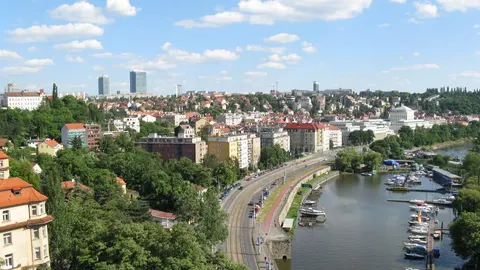
Accessible Prague is possible, but the most reliable trip is built from specific verified routes rather than a blanket promise that the historic center is step-free. Confirm the hotel room, airport assistance, station lifts and attraction entrances separately. Cobblestones, hills and uneven access between metro stations mean that the shortest route on a map is not always the usable one. [1][5][6]
Make the hotel room the first confirmed part of the trip
Ask for the features you need in the actual room category, not a general statement that the hotel is accessible. Door widths, bed height, transfer space, shower configuration and toilet positioning can determine whether a room works independently or requires assistance.
Request photographs and measurements when any feature is critical. A bathroom described as adapted may still have a shower lip or a layout that does not suit your transfer direction. A hotel entrance can be step-free while the breakfast room or terrace is not.
Get confirmation that the suitable room is reserved, rather than merely requested. Clarify what happens if it becomes unavailable and whether a proposed alternative has the same essential features. This is particularly important when booking a restrictive rate through an intermediary.
Location should be judged by usable connections, not only proximity to a famous square. A property slightly farther away but served by a reliable step-free route may be more practical than one surrounded by steep cobbled lanes. Keep an alternative route in mind so that one lift outage does not isolate the hotel from the day's activities.
Arrange airport assistance with enough notice
Prague Airport publishes assistance for passengers with reduced mobility or orientation needs. Its guidance mentions advance notification, while the Czech Civil Aviation Authority's general information uses the established forty-eight-hour notification framework. A practical conservative approach is to notify the airline or booking agent at least forty-eight hours ahead and describe the help required. [3][4]
Separate the different needs: walking long terminal distances, using aircraft stairs and moving to the seat are not the same task. Explain whether you travel with your own wheelchair or another mobility aid and provide the airline with its dimensions, weight and battery information where relevant.
Keep handling instructions and photographs of your equipment available. Removable controls, cushions and other components should be managed according to the airline's agreed procedure. Requesting airport assistance does not automatically communicate every detail about a personal device.
The airport service and the hotel transfer are separate arrangements. Confirm where assistance ends, where a driver will meet you and whether you can remain seated in the wheelchair in the booked vehicle. A large taxi is not necessarily an accessible vehicle with appropriate restraints.
Check the station, exit and live lift status
Prague's metro does not offer the same step-free access at every station. DPP publishes station-specific accessibility information and a separate live status page for lifts and platforms. Use both: a station designed with a lift can still be temporarily unusable if that lift is out of service. [1][2]
Check the route shortly before leaving, not only when planning the trip weeks earlier. Identify the correct street entrance and any transfer between lines. A journey planner may show a geographically convenient station while omitting the practical detail that the accessible entrance is on another side of a busy road.
When a lift is unavailable, the best alternative may be a surface route rather than the next metro station. Compare the whole journey, including gradients and pavement conditions, before choosing a replacement.
The tourist board's accessible transport guidance and DPP's tram information help identify suitable services. Low-floor vehicles and stop design are separate considerations, so look at the actual departure and boarding arrangement rather than assuming every tram on a route has identical access. [5][11]
Allow time to signal your needs clearly and board safely. A plan that depends on catching a single vehicle at the last second creates avoidable pressure for both traveler and staff.
The Lesser Town needs a route, not just a destination pin
Prague City Tourism's Lesser Town route provides detailed access information, including limitations that are easy to miss on an ordinary map. Malostranská metro station is not a step-free option, despite its convenient location for many visitors. [6]
Use the recommended surface approach and read the details of individual crossings, slopes and toilets. A short distance can still be difficult when it includes rough paving, a steep ramp or a narrow passage. The point is not to avoid the area altogether, but to choose a route suited to your equipment and assistance needs.
For Kampa or a riverside outing, establish the usable entrance to each indoor stop. A museum's postal address may lead to its principal staircase while the accessible entrance lies elsewhere. Save the entrance instructions offline so that a weak phone connection does not remove essential information.
Keep the outdoor segment modest at first. After experiencing the surfaces, you can decide whether to extend the route. This is more comfortable than committing to a long circuit whose return half is equally demanding.
Approach the castle district with elevation in mind
Hradčany's appeal includes its elevated setting, but that also makes the approach important. The tourist board's barrier-free route offers a more useful starting point than simply following the most direct pedestrian line uphill. [7]
Arrange transport toward a suitable higher-level starting point when that reduces a difficult climb, then verify the route between the places you want to see. Do not assume that a downhill path is automatically easy: steep descent can be challenging for braking, balance and assistance.
Inside historic complexes, access may vary by building or room. Ask about the exact circuit and whether an alternative entrance requires staff assistance. A ticket covering several buildings does not establish that every included space is reachable by the same route.
For a companion group, agree which optional sections can be skipped without separating anyone involuntarily. A shared shorter visit is often more satisfying than a nominally comprehensive itinerary that repeatedly leaves one person waiting outside.
Choose museums by their actual access information
Prague's tourism authority publishes culture-specific accessibility guidance, which is useful for identifying institutions worth contacting. Follow up with the venue about the current exhibition, lift coverage, toilets and any loan equipment. [8]
A temporary exhibition can be in a different part of a building from the permanent collection. Ask where the works you want to see are displayed, not simply whether the museum has a lift. The answer should connect the entrance, exhibition and essential facilities into one workable visit.
Towers require particular caution. The tourism authority distinguishes the Old Town Hall's lift arrangements from the more limited access at other historic towers. A general recommendation to climb Prague's towers is not appropriate for every traveler, and a lift to one level does not necessarily remove all steps at the final viewpoint. [9]
Choose a viewpoint for its usable route rather than its fame. An accessible terrace, riverside perspective or elevated arrival point may provide a satisfying view without the same physical demands as a tower climb.
Plan toilets and rest stops as essential infrastructure
Mark suitable toilets near the beginning and end of a longer outing. Confirm whether they lie inside a paid attraction, require a key or are only available during business hours. The tourist board's information and service pages can help identify resources, but the actual facility details still matter. [10]
A café described as welcoming may have a basement restroom. Ask before relying on it for a long break. Likewise, a restaurant reservation should include confirmation of the entrance and table route when narrow passages or steps would affect the meal.
Build in places to stop before fatigue becomes the reason to abandon the day. Rough surfaces, cold weather and crowded approaches can make a short map distance more tiring than expected. A reliable indoor break is not wasted sightseeing time; it helps preserve the rest of the visit.
Accessible Prague works best when the critical details are settled and the optional parts remain flexible. Confirm the room, assistance, transport and entrances, keep live lift information available, and choose a pace that leaves room for adjustment. That approach preserves the traveler's control rather than making the trip depend on optimistic assumptions.