
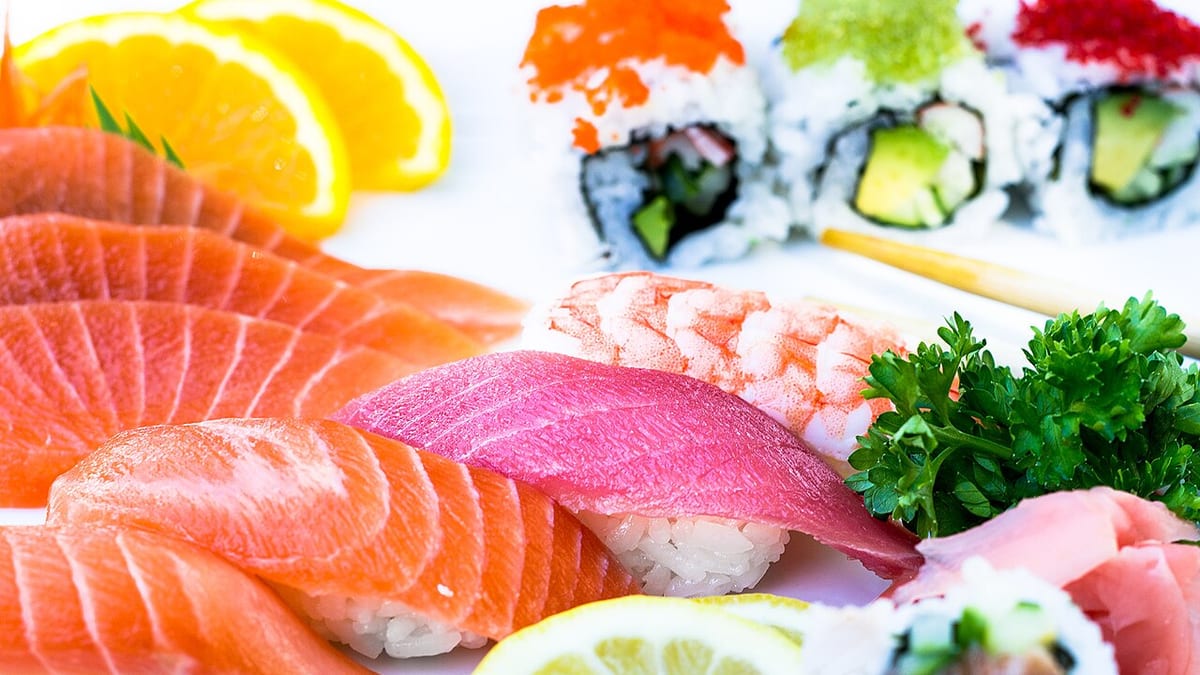
For sushi in Prague, choose Masami when a clearly priced mixed set is the priority, Miyabi when you want a broader Japanese meal with several set options, and Yamato for a more structured lunch or tasting-menu occasion. Compare the number and type of pieces, not just the headline price: a large roll set and a nigiri-focused menu are different meals. [1][2][4]
Masami: a straightforward set-price starting point
Masami's published menu lists a 20-piece set at CZK 430, an eight-piece nigiri set at CZK 480 and miso soup at CZK 100. These give budget-conscious visitors a useful starting point without pretending that every piece carries the same ingredient cost or eating experience. [1]
A CZK 430 set plus the CZK 100 soup totals CZK 530 before drinks or other additions. That is a calculation from the listed items, not an all-inclusive restaurant package. An eight-piece nigiri selection costs more than the 20-piece set because "pieces" are not interchangeable units of value. Read the composition before deciding which is the larger or more satisfying meal. [1]
This format suits a visitor who wants to make a relatively simple order and keep the main cost visible. It is less useful to compare the set directly with a restaurant's multi-course dinner that includes dishes beyond sushi. Choose the structure that fits the evening rather than judging one establishment by another's menu format.
For a shared order, establish whether both diners want the same ingredients. A large set is only good value when its contents suit the people eating it. Adding several replacement rolls because half the set is unwanted can undermine the apparent saving.
Miyabi: distinguish sushi sets from lunch boxes
Miyabi at Navrátilova 10 offers several ways to structure a Japanese meal. Its menu lists the Seppiko selection of 11 pieces at CZK 590 and the Azuma selection of 12 nigiri at CZK 1,290. The difference is not simply one additional piece; the composition and style of the set are central to the comparison. [2][3]
The restaurant also lists a 19-piece vegetarian selection at CZK 830. Importantly, that selection includes tamago, so "vegetarian" should not be read as "vegan." Anyone avoiding eggs needs a different confirmed arrangement, not an assumption based on the absence of fish. [2]
Miyabi's weekday bento offer has been listed at CZK 390 during the Tuesday–Friday lunch window, 11:30–14:30, while available. A bento is not automatically a sushi lunch. Read the day's contents and select it because you want that meal rather than because it is the lowest number beside a Japanese restaurant's name. [3] [6]
The distinction is useful when planning a modest lunch before a more substantial dinner. A bento may meet that need perfectly, but someone specifically seeking a range of nigiri should compare the relevant sushi menus instead.
Access also deserves more than a general label. Miyabi's visitor information distinguishes its front area from spaces reached by steps and a toilet reached by a spiral staircase. A guest who requires step-free facilities should discuss the actual seating and bathroom arrangement before reserving. [3]
Yamato: lunch offers a different commitment from dinner
Yamato's weekday lunch service is listed from 12:00 to 14:45. Its sushi lunch is CZK 780 and includes four nigiri, six hosomaki, soup, dessert and tea. A vegetarian lunch is listed at CZK 690. Here, the useful comparison is a complete lunch format rather than the sushi pieces alone. [4]
For two diners choosing the CZK 780 lunch, the menu total is CZK 1,560 before anything ordered outside the package. If ordering an eligible takeaway meal and the listed CZK 50 packaging charge applies to each, two meals plus two packaging charges total CZK 1,660. Confirm the ordering conditions rather than assuming that every dine-in lunch offer can always be taken away. [4]
Dinner is a separate proposition. The tasting menu is listed at CZK 3,500 per person with a minimum of two diners, and the optional sake pairing at CZK 1,300 per person. Two tasting menus therefore total CZK 7,000; adding two sake pairings brings the calculation to CZK 9,600. These figures should not be presented as the price of a casual sushi platter. [5]
Choose that dinner for an evening centered on the restaurant. It is not the logical option when you need to eat quickly between sightseeing and a performance. Ask about the expected duration and dietary arrangements when booking, particularly because a minimum-party tasting format may leave less flexibility than individual à la carte dishes.
Compare the whole meal rather than price per piece
A price-per-piece calculation can be misleading when one menu contains small rolls and another emphasizes nigiri or includes soup, dessert and tea. It can still be useful within a clearly comparable category, but it should not become the sole definition of value.
Write down what you actually intend to order. For a light lunch, one set and a drink may be enough for your purposes. For a longer evening, calculate starters, additional sushi and beverages. A low initial set price can grow substantially if it does not match the meal you wanted.
For two people, sharing several different sets may create variety, but it is not automatically cheaper than one complete menu each. The advantage is choice, not a guaranteed saving. Decide whether the priority is trying more ingredients, controlling spending or enjoying a paced dining experience.
Do not use a restaurant's address or menu design as evidence of quality that has not been independently established. These recommendations are based on published formats, prices and practical differences. They are not claims of personal tasting or a definitive citywide ranking.
Dietary needs change the shortlist
Vegetarian, vegan and fish-free are different requests. Miyabi's tamago-containing vegetarian set provides a concrete example of why the label alone may not resolve the question. Ask about the actual ingredients of sauces, broths and garnishes as well as the visible topping. [2]
For allergies, communicate directly with the restaurant before ordering and ask whether it can safely accommodate the requirement. An ingredient list can help identify a dish that is unsuitable, but it does not establish how the kitchen handles cross-contact. Do not treat a suggested substitution as a guarantee.
Likewise, someone who prefers cooked ingredients should ask which complete set can meet that preference. Replacing several items individually may change both the price and the balance of the meal. A different menu can be simpler than trying to redesign a fixed selection at the table.
Match the restaurant to the occasion
For a clear, relatively modest set-price meal, begin with Masami's current menu. For a broader Japanese restaurant experience with choices spanning bento and more substantial sushi sets, consider Miyabi. For a structured lunch or a dinner that becomes the main event of the evening, examine Yamato's relevant menu rather than comparing its tasting price with a takeaway-style set. [1][2][4][5]
The best choice is the one that matches your appetite, time and desired format. Once those are clear, the prices become useful information rather than a collection of numbers that appear comparable but describe different experiences.