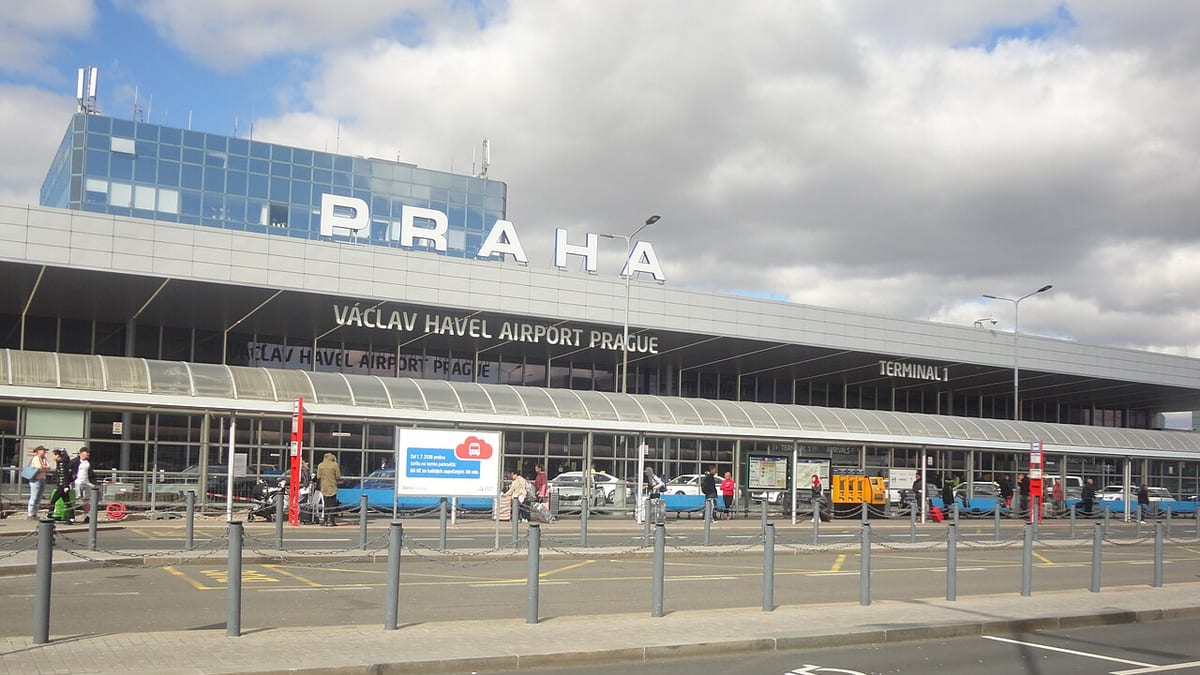
At Prague Airport, passport control mainly concerns journeys crossing the Schengen external border, using Terminal 1. Terminal 2 handles Schengen flights. For affected non-EU visitors, EES registration adds a digital border process, and the airport has acknowledged operational pressure around it. Leave flexibility after arrival and understand your transfer route rather than relying on a fixed immigration waiting time. [1] [2]
What happens at Terminal 1
For a non-Schengen departure, Prague Airport describes the sequence as check-in, boarding-pass control, passport control and then security at the departure gate. This differs from Terminal 2's centralized security arrangement. Clearing passport control is therefore not the final checkpoint before boarding a Terminal 1 flight. [1]
Keep moving toward the gate when the flight information tells you to do so. A restaurant in the departure area may look conveniently close, but you still need to allow for the gate's security process and the airline's closing time. The sensible point for a leisurely pause is after establishing which formalities remain, not simply after seeing the first duty-free shop.
For an arrival from outside Schengen, follow signs for the border-control process appropriate to your documents. The arrival and departure procedures are related but not identical; a description of your outbound journey is not a reliable map for the return. Staff directions also take precedence over a photograph of an older terminal layout.
Nationality and route answer different questions. The route determines whether you are crossing the external border; nationality and status determine entry requirements, EES treatment and which lanes are appropriate. An EU passport does not turn a London arrival into an internal Schengen flight, and a non-EU passport does not automatically create an external-border check on every flight within Schengen.
The current EES issue is real, but a universal queue estimate is not
On 1 October 2026, Prague Airport published an action plan addressing border checks for passengers arriving from non-Schengen countries. The measures include multilingual information, assistance around self-service kiosks, improved passenger-flow coordination and work with the authorities on processing capacity. This is concrete operational context, not evidence that every arrival experiences the same delay. [2]
The useful planning response is to preserve flexibility. Do not arrange a nonrefundable train or a timed attraction on the assumption that landing, immigration and baggage reclaim will always fit into a short interval. A traveler with no checked bag still has no control over how many other flights reach the border area at the same time.
Equally, avoid converting individual reports of very long queues into an official average. An anecdote can warn you that delays are possible; it cannot tell you the expected wait for your flight. This guide does not claim a measured median or promise that choosing a particular arrival hour avoids the problem.
For a prebooked car, give the operator your flight details and understand how its waiting allowance is measured. An allowance beginning at landing can be less useful than one that takes account of the actual arrival process. Resolve that commercial condition when booking, not while standing in an immigration line.
Kiosk instructions and legal exemptions are not the same thing
Prague Airport asks covered arriving non-EU/non-Schengen passengers to use the EES kiosks before approaching border control. Its local instructions list exceptions for certain travelers, including residence-permit or long-stay-visa holders, crew, people with reduced mobility, children below the stated age or height threshold, and holders of non-biometric passports. Ask staff which route applies rather than attempting an unsuitable machine. [3]
The important qualification is that exemption from using a kiosk does not necessarily mean exemption from the EES itself. A child may need a staffed process even though fingerprints are not collected. EU guidance says children under twelve are not fingerprinted, while other registration requirements can still apply. Equipment eligibility and legal registration obligations should not be collapsed into one rule. [4]
Similarly, a traveler whose document cannot be read by a particular machine should seek the staffed route, not assume the journey is impossible or that the border procedure can be skipped. Keep all relevant status documents with the passport, especially when residence rights or a long-stay visa affect how the person should be processed.
The airport recommends the EU/EEA/CH lane for eligible nationals. Use the signs and assistance team to resolve a mixed-nationality family's route. It is better to ask once than to complete the wrong queue and discover that a family member still needs a separate step. [3]
Connections require more than a terminal walking time
Prague's official transfer guidance distinguishes connections within one terminal from journeys between Terminals 1 and 2. An airside transfer between the two includes passport control and security. Within Terminal 1, the published procedure includes gate security; within Terminal 2, the standard airside transfer can proceed to the assigned gate without another security check. [5]
Those descriptions assume the relevant airside transfer arrangement. They should not be applied blindly to separate tickets with baggage that must be collected. Confirm at the departure airport where your suitcase is tagged and whether the onward boarding pass is available. A printed itinerary containing both flights is not proof that the airlines will transfer the bag.
A practical comparison illustrates the difference. A passenger arriving on one booking with a through-checked bag may follow transfer signs. A passenger holding separate tickets who must collect luggage has an arrival process followed by a new departure process. The same scheduled interval can therefore produce very different demands, even when both travelers are connecting between the same terminals.
For non-Schengen-to-non-Schengen travel, the airport publishes an airside Terminal 1 transfer procedure, but document and airline requirements still matter. Do not assume that a particular nationality is exempt from an airport-transit visa or that every separate-ticket combination supports the same route. Confirm the actual itinerary with the responsible airline and relevant authority.
Prepare the documents before approaching the desk
Have the passport open and any required residence card, visa, accommodation details or onward travel evidence readily available. For ordinary non-EU short-stay visitors, EU guidance sets requirements for passport age and remaining validity and explains that supporting evidence may be requested. These conditions should be checked before travel, not discovered at the booth. [6]
A photo of a document can be useful as a backup record, but do not treat it as a replacement for an original document required for entry. Keep the essentials in hand baggage and avoid burying them in a laptop case you must unpack while the family waits.
If a delay threatens an onward flight, notify airline or transfer staff early and explain the booking arrangement. Do not leave a queue without understanding where to go next, and do not assume a paid Terminal 2 security pass provides priority at Terminal 1 passport control. Those are different services. [7]
The most useful approach is simple: know which border you are crossing, use the correct registration route, keep the documents together and avoid making the rest of the day depend on an invented queue estimate. Prague's current operational notices justify extra flexibility, not panic or a claim that every passenger will face the same experience.
Sources
- Prague Airport: travel documents and terminal procedureswww.prg.aero
- Prague Airport: EES action plan, 1 October 2026www.prg.aero
- Prague Airport: EES kiosk instructionswww.prg.aero
- European Union: Entry/Exit System questions and exemptionstravel-europe.europa.eu
- Prague Airport: transfers within and between terminalswww.prg.aero
- European Union: travel documents for non-EU nationalseuropa.eu
- Prague Airport: Security FastTrack prices and restrictionswww.prg.aero