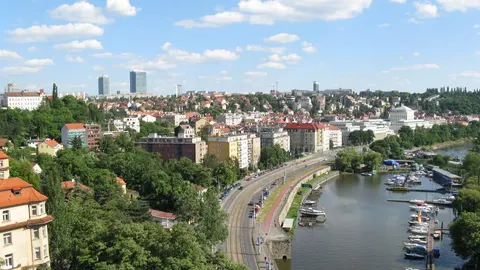
Prague in September suits travelers who want substantial time outdoors without making the whole trip depend on summer conditions. Plan walks and gardens alongside an indoor alternative, then book music or wine events for their actual dates. September 2026 has already passed; its festival listings are useful examples of the season, not confirmed dates for September 2027. [1] [2]
Pack for a transition, not a guaranteed extension of summer
Czechia's official tourism guidance describes September as an early-autumn month that can retain relatively warm conditions. That is a seasonal description, not a forecast for a particular weekend. A trip should be comfortable if an afternoon is pleasant and still workable if rain or a cooler evening changes the plan. [1]
A light outer layer, something warmer underneath and shoes suitable for prolonged walking are more useful than packing entirely for one temperature. Keep the rain layer accessible during the day rather than leaving it in the hotel because the morning looked promising. For an evening concert, choose an outfit that can also handle the journey home.
Do not read a monthly average as the temperature you will experience throughout every day. Climate normals describe a historical reference period; the Czech Hydrometeorological Institute explicitly distinguishes them from the conditions of a particular month or year. Use the short-range forecast close to departure to make final packing decisions. [3]
For sightseeing, make the itinerary movable. A garden visit, an extended riverside walk or a viewpoint belongs in the most suitable weather window. A museum visit can take the less favourable part of the day. This is more effective than buying a rigid sequence of timed indoor admissions and then finding that the best outdoor weather occurred between them.
Music can be a reason to choose the dates
The 2026 Dvořák Prague Festival ran from 5 to 23 September, with orchestral, chamber and recital programmes across several venues. Its official programme identifies the actual performers, works and halls. That matters more than a generic promise of "classical music in Prague." [2]
For a future September trip, start with the new edition's programme once released. Select a performance that interests you, then arrange dinner and the surrounding sightseeing around its venue and start time. Do not assume that an orchestra appearing in one year's programme returns on the same date the next year.
The venue also changes the evening. A large orchestral concert and a smaller chamber performance offer different experiences even when both belong to one festival. Read the programme before choosing the cheapest remaining ticket, and examine the seat information when sightlines or stairs matter.
A performance need not turn the whole day into a formal occasion. My recommendation is to keep the preceding afternoon geographically compact and leave a proper interval for a meal. Avoid returning from a long excursion at the last plausible moment; a delayed connection should not threaten the main reason for choosing the trip dates.
For visitors without a fixed musical preference, it is reasonable to choose the city first and add a concert later. The mistake is treating a festival name as an automatic recommendation without checking what is actually being performed.
Wine events are dated occasions, not permanent attractions
Prague Castle's 2026 wine-harvest festival took place on 5–6 September in the Royal Garden. That is a specific past event. The Royal Garden's ordinary visitor access and a festival held there are separate reasons to visit, with potentially different arrangements. [4]
A future wine event can be a pleasant focus for an afternoon, but choose it for the event itself. Someone whose priority is an unhurried architectural walk may prefer a different time from a busy festival programme. Someone who does not drink can still assess the accompanying activities, but should not assume that every event offers the same non-drinking experience.
Read what admission includes. A festival entrance charge, tasting tokens, an individual glass and a food purchase are not necessarily interchangeable. Budget for the components you actually want rather than comparing the word "free" on one event listing with the cost of a complete visit elsewhere.
Avoid building a future itinerary from an undated social-media image. A photograph of stalls beside a landmark establishes neither the next event date nor the venue's normal operation. The organizer's current edition is the useful source; archived information should remain labelled as archived.
Keep the central sightseeing days coherent
For a first visit, use one day for the castle side of the river and another for the Old Town and nearby indoor collections. Prague Castle distinguishes access to the grounds, historic buildings and gardens, with different operating schedules. A longer outdoor opening window does not mean that every interior remains open for the same hours. [5]
On a favourable morning, take the outdoor parts seriously rather than racing through them on the way to another ticket desk. Leave enough time to understand the relationship between the castle, the slopes below it and the river. Then choose one substantial interior instead of treating every available attraction as compulsory.
A wet afternoon is a reason to change emphasis, not to cancel the day. Choose a museum whose collection genuinely interests you, allow time to use it properly and avoid filling the interval with repeated short shop visits simply to remain dry. A café stop is most satisfying when it is a deliberate break rather than the fifth emergency shelter of the afternoon.
Prague's transport tickets can make these adjustments easier. The current standard adult 24-hour ticket costs CZK 140 in the PID Lítačka app or CZK 150 on paper and runs for 24 hours from activation or validation. It is not restricted to the calendar date printed on your itinerary. [6]
Match the trip length to your priorities
With two full days, keep the main programme in Prague. Adding a long excursion simply because September sounds suitable for travel can leave the city visit feeling rushed. A third or fourth day creates more room for a park, a neighbourhood outside the central sightseeing circuit or a dedicated day trip.
For a music-focused stay, count evenings as valuable time. Two concerts on consecutive nights can be a rewarding purpose for the trip, but they reduce the appeal of long daytime journeys. For an outdoor-focused stay, preserve the ability to swap days rather than prepaying every hour.
Accommodation should support that choice. Compare the final route home from an evening venue, not only the distance to the Old Town Square. The metro does not run all night in ordinary service; night trams and buses form a different network. [7]
September is a strong fit when you enjoy combining the city's outdoor setting with its cultural programme and can accept that weather remains variable. Book the event that matters, keep the rest of the day flexible, and use future announcements rather than rolling expired 2026 dates into a new year's plan.