
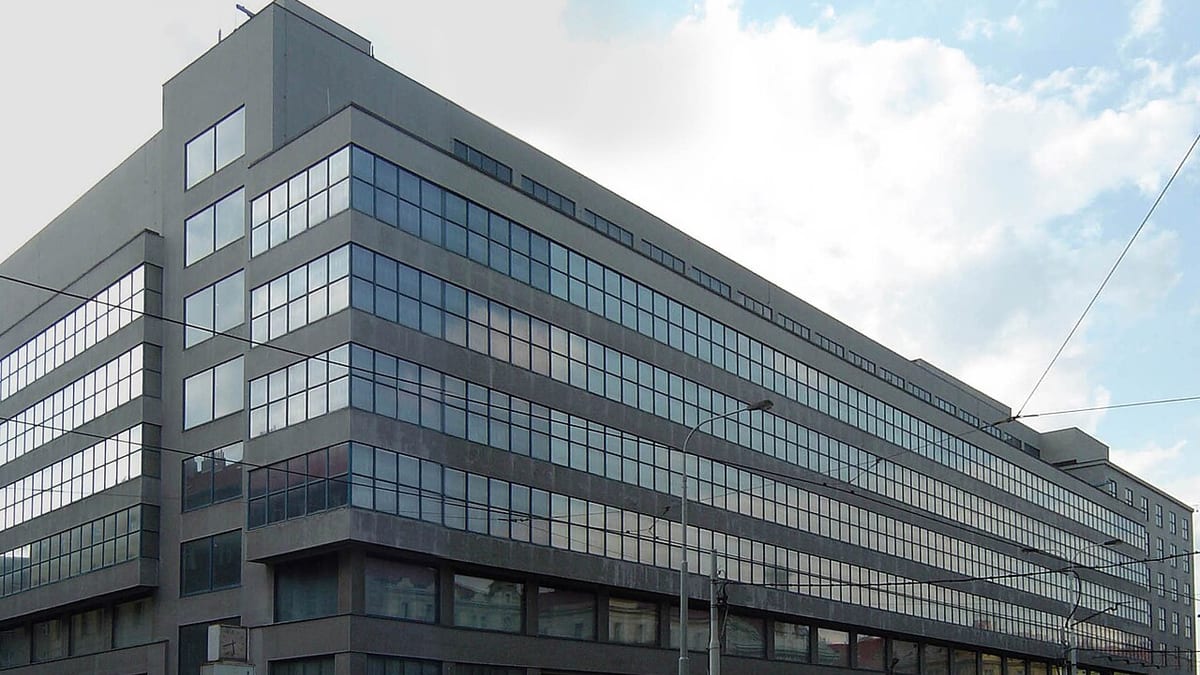
The National Gallery's Trade Fair Palace is worth visiting when you want to understand Czech art alongside broader European developments and can give a large collection focused attention. Choose one or two historical periods rather than trying to absorb every floor. The standard collection ticket covers the palace's collection displays, not automatically every National Gallery building across Prague. [1][2]
The building itself sets the scale
The Trade Fair Palace stands at Dukelských hrdinů 47 and was designed by Josef Fuchs and Oldřich Tyl in the 1920s. Its large functionalist spaces make it a different museum experience from a palace converted into small historic galleries. The architecture is part of the visit, not merely a container for the pictures. [1]
Take a moment to understand the building's layout before entering the first collection. Identify where the periods that interest you are located and how you will move between them. A clear route prevents the feeling of repeatedly arriving in another enormous room without knowing how it connects to the last.
The scale can be stimulating for an art enthusiast and overwhelming for a casual visitor. Neither response is wrong. The solution is to choose a manageable part of the museum rather than treating the admission price as an obligation to complete every level.
A useful visit can center on one question: how did artists respond to a changing society, how did Czech work connect with international movements, or how did the purpose of an image change across different political periods?
Choose a period that gives the visit direction
The collection titled 1796–1918: Art of the Long Century offers one route through the nineteenth century and its extended cultural setting. The 1918–1938 presentation focuses on the First Czechoslovak Republic, while the later Czech art display extends through 1939–2021. These are distinct ways into the collection, not simply three interchangeable floors of similar paintings. [3][4][5]
For a visitor unfamiliar with Czech art, a chronological section can provide a useful framework. Read the introductory material, then select a few works that show contrasting approaches rather than attempting to memorize every artist's name.
Someone already interested in modernism may prefer to begin with the interwar period. A traveler concerned with more recent history may find the later collection more relevant. Start where your curiosity is strongest and use another section as a comparison if time and energy allow.
Do not judge the collection only by the number of internationally famous names you recognize. The opportunity to encounter artists and contexts less familiar at home is one of the strongest reasons to visit a national collection while traveling.
Understand what the ticket actually covers
The gallery lists standard collection admission at CZK 250, with a reduced category at CZK 140 under its eligibility conditions. The relevant collection ticket covers the collection displays within Trade Fair Palace rather than requiring a new ticket for every historical period there. [2]
That does not make it a universal pass to all National Gallery sites. The institution operates several buildings, and broader products have their own scope and validity. The published ten-day option is listed at CZK 750, but it only makes sense when the included visits match a real itinerary. [2]
For a traveler interested only in this palace, paying for a wider pass can be unnecessary. For someone planning several National Gallery buildings, compare the individual products and actual dates before deciding. The right calculation is based on intended visits, not on the maximum number theoretically possible.
Temporary exhibitions may have separate conditions. Read the product associated with the show you want rather than assuming that the word gallery on both pages establishes inclusion.
A dated anniversary exhibition is not permanent
The gallery's 230 Years exhibition is scheduled from March 26, 2026 to January 3, 2027. At this article's November 6, 2026 publication date, that is a current temporary programme with a stated end, not a permanent feature to promise to every future visitor. [6]
Choose it when its subject interests you and your dates fall within the confirmed period. A visit after the closing date needs a different temporary-exhibition plan, even if the collection displays continue to provide a strong reason to go.
This is also a useful distinction when reading older recommendations. A writer may have praised an exhibition that genuinely made their visit special, but that does not mean the same work is still installed. Use current programme pages to turn general inspiration into an accurate booking decision.
Keep any must-see work or exhibition separate from the broader claim that the museum is worthwhile. The institution can remain rewarding even when one temporary attraction has ended, but the reason for your personal visit may need to change.
Give the art time without exhausting the group
A focused plan might begin with one collection period, include a break and finish with a small selection from another. That provides comparison without demanding continuous attention across the whole building.
For families, ask a few concrete questions about what is visible: how a city is represented, what materials an artist chose or how a portrait communicates status. Avoid turning every room into a lecture. Children and adults alike often engage more deeply with a small number of works than with a rapid survey.
For companions with different interests, agree on a meeting point and a reasonable amount of independent time. A large museum does not require everyone to stand before the same painting for the same duration.
The palace normally opens Tuesday to Sunday from 10:00 to 18:00. Plan the visit within that schedule rather than treating it as a dependable Monday alternative when other museums are closed. [1]
Access and facilities support a longer visit
The National Gallery's access information describes lifts, accessible toilets and two wheelchairs available for loan at Trade Fair Palace. A visitor who depends on loan equipment should reserve or confirm it rather than assuming that a small supply will always be free on arrival. [7]
Ask about the exact entrance and the route to a temporary exhibition when those details matter. An accessible building can still have an exhibition layout or operational arrangement that deserves clarification.
Keep essential belongings manageable and use the museum's storage rules for larger items. The aim is to make looking comfortable, not to carry the entire day's shopping through every gallery.
Choose Trade Fair Palace for a deliberate art visit, not merely as a rainy-day space to fill. Its strength is the chance to connect Czech work, international developments and modern architecture in one substantial institution. A selected period, the right ticket and a realistic pace make that breadth useful rather than overwhelming.